
Eric Inksmith
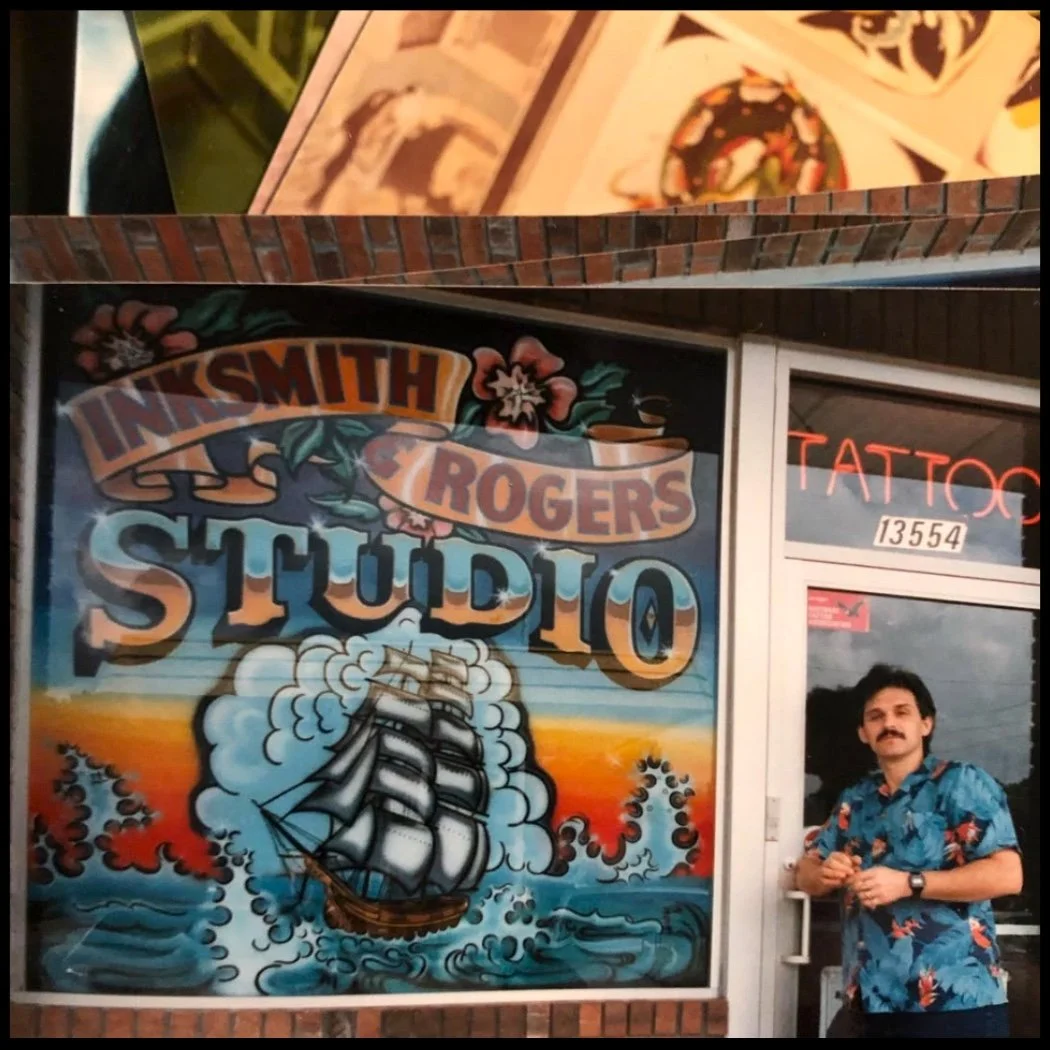
Eric Inksmith has appeared on local and national television programs, including the Today Show, playing a key role in bringing tattooing into mainstream popularity. At the height of his career, he owned the largest network of tattoo shops across northern Florida and New Mexico. Renowned for his vibrant pigments and masterful application of colors that enhance and complement one another, Eric is celebrated as a brilliant tattooer and craftsman. He has been both a witness to and a driving force behind the evolution and rise of tattooing in America.
After years in the industry, Eric had the fortune to meet Paul Rogers, a veteran carnival tattooist who had perfected the art of building tattoo machines. Paul generously shared his techniques and insights, making Eric the heir to his mechanical expertise—a vital skill for any tattoo artist. Their bond deepened when Paul convinced Eric to relocate to Jacksonville, where their friendship and professional collaboration flourished. To honor Paul, Eric founded their joint venture, Inksmith© & Rogers™.
That same spirit of generosity endures among our staff today, fostering a culture of mutual support, care, and shared creativity. Team members regularly collaborate on flash painting parties, group outings, and knowledge-sharing sessions. They also champion one another's diverse artistic pursuits, from graffiti and leather carving to pin-striping, motorcycle building, wood turning, and fly fishing.
Now residing in Mora, New Mexico, Eric maintains his passion for tattooing while exploring wood carving and engraving. In recent years, he has expanded his engraving work to include tattoo machines and firearms. Eric takes great pride in the enduring communal ethos and collaborative spirit that define Inksmith© & Rogers™.
Paul Rogers
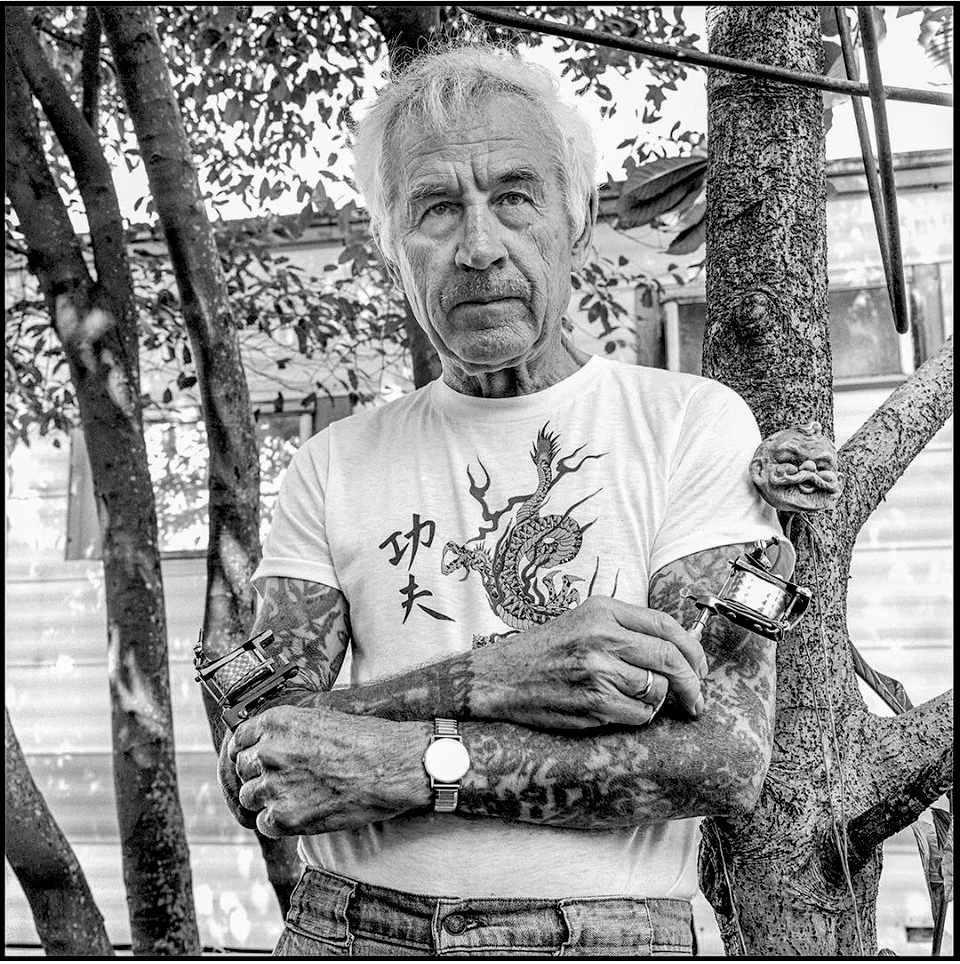
Paul Rogers was born on September 9th 1905 in North Carolina, and spent most of his childhood moving from one cotton mill town to the next. Paul started to work in the mills when he was only 13 years old. Paul worked in the cotton mills until he was 37 years old. In 1926 when Paul was 21, he got his first tattoo and found his lifetime occupation.
Only two years later he was tattooing with a kit he mail ordered from E.J. Miller in Norfolk, Virginia. In 1932 after tattooing all the folks around his home, Paul hit the road with the J.J. Page Show in search of adventure and clean skin. Later that very same year, Paul joined the John T. Rea Happyland Show where he met and married the boss's daughter, Helen Gensamer. For most of the next decade Paul and Helen worked the carnival circuit in the summers and worked in the cotton mills during the winters.
In 1942 when Paul got a chance to tattoo in Charleston, South Carolina, he jumped at it. At this time his pay envelope from the mill for a 40-hour workweek was $42, which was the biggest payday he ever had in the mills.
After getting his shop up and rolling, Paul now was making $150 to $200 a week! Needless to say, Paul never went back to the mills. In 1945 Paul began a 5 years association with Cap Coleman of Norfolk, Virginia. Coleman was already a legend in the tattoo world and Paul said it was like a dream come true to be invited to work with Coleman. Paul stayed in Norfolk until 1950, when the city fathers shut down tattooing in that city. Coleman moved across the Elizabeth River to Portsmouth, Virginia and tattooed for a few more years.
Paul and Lathan Connelly opened shops in Petersburg, Virginia and Jacksonville, North Carolina. In 1955 when Paul grew tired of traveling between these shops, he took the Jacksonville location and Connelly took the Petersburg shop. This is where the mail order supply business of Spaulding & Rogers was formed. Paul was involved in this business for only a couple of years, but Paul and Huck Spaulding worked together in Jacksonville up until 1961. In 1960 they closed their shop on Courts Street and went to Alaska. This only lasted for one month and they returned back to Jacksonville, North Carolina soon after.
From 1961 to 1963 Paul and his family lived in Camden, New Jersey where Paul tattooed with Sailor Eddie Evans. In 1963, he moved to Jacksonville, Florida and tattooed with Bill Williamson. The very next year Bill Williamson died and Paul inherited his shop. By 1970, Paul was back working in Jersey with Ernie Carafa on a part time basis.
In 1970 Paul and Helen Rogers bought a mobile home at 1200 Shetter Avenue #3 in Jacksonville, Florida. It was here that Paul brought his decades of experience together with what he had learned from the likes of Coleman, Bill Jones, Jack Wills, Charlie Barr and others, and built some of the best running tattoo machines in the business. In 1982 Helen, Paul's wife of 49 years, died. She was buried at the Greenlawn Cemetery in Portsmouth, Virginia. In 1983 Paul Rogers was admitted to the Tattoo Hall of Fame in San Francisco, California, which was part of the Tattoo Art Museum created by Lyle Tuttle.
Paul died in 1990, at the age of 84, after spending 56 years in the tattoo business. He was buried with his wife in Portsmouth, Virginia.